Czech Republic Embassy Interview Tips for Pakistani Students
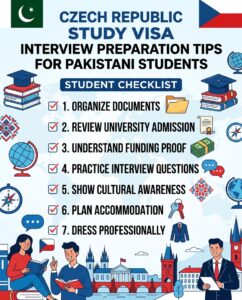
The Czech study visa interview is a formal meeting where a consular officer verifies your identity, academic documents, and genuine intent to study in the Czech Republic. This guide helps Pakistani students prepare for their visa appointment. It covers common questions, document checks, and practical tips to pass your interview with confidence.
Is There an Interview for the Czech Republic Study Visa?
An embassy interview isn’t always mandatory, but it is required if the consulate invites you. Officers use it to verify your genuine study intent and background. Unlike short-stay Schengen interviews that focus on brief tourism and return dates, long-term Czech study visa interviews assess your academic plans, university choice, and financial readiness, along with the official Czech study visa requirements.
How the Czech Embassy Interview Works in Islamabad
The visa interview at the Czech Embassy in Islamabad evaluates your identity, documents, and study plans. Candidates navigate an initial appointment check, structured officer questions, and post-interview file processing.
Booking Your Appointment
You must send a registration email during the monthly application window. The embassy selects applicants through a random lottery system and sends confirmed slots. Appointments are completely free. The embassy does not use third-party agents or ticket sellers. Always check the official Czech Embassy site to confirm exact registration dates.
Interview at Submission vs. Separate Invitation
Applicants either undergo a quick check during submission or receive a formal invitation for a deeper assessment later. Understanding both formats helps you prepare effectively for officer questions and official documentation.
| Aspect | Interview at Submission | Separate Invitation |
| Format | Short counter chat | Formal in-person interview |
| When | During document submission | Scheduled weeks after submission |
| Duration | 5 to 10 minutes | 30 to 60 minutes |
| What to Expect | Quick document check and brief questions | Detailed written record in Czech, deep verification, and an option for an interpreter |
Who Decides Your Visa?
The consular officer collects your documents and conducts the interview, but the Czech Ministry of the Interior makes the final decision. The statutory processing time for study visas takes roughly 60 days. After your interview, a few key steps remain before departure. Read our guide below on what happens after the interview.
Documents to Carry and Be Ready to Explain
Consular officers frame every required document as a potential interview question to test your authenticity. Bring all original documents alongside one complete set of physical photocopies.
- Academic Proof and Purpose of Stay
- Financial Means and Sponsorship Documents
- Accommodation and Legal Records
Admission Letter and University Details
Officers test this section to confirm that you selected your degree program independently and genuinely. You must know these details cold:
- University name: Exact title and campus location.
- Program details: Full degree name, core subjects, and course duration.
- Instruction language: Official medium of teaching for your course.
- Tuition fee: Exact annual cost and payment receipts.
- Start date: Official commencement day of your academic term.
- Application process: Step-by-step method you used to apply.
- Correspondents: Names of university officials who handled your admission
Financial Documents and Sponsor Proof
Officers examine your bank statement to confirm you can afford living costs without unauthorized work. You must present a 6-month bank statement stamped by your bank. Be ready to explain your relationship with your sponsor, your overall source of funds, and your income stability. Spoken answers must match your statement figures exactly to avoid visa refusal. Learn how to prepare compliant proof in our guide to bank statement requirements.
Accommodation, Criminal Record Extract and Attested Documents
Pakistani applicants must provide a clean criminal record extract with official attestations from the IBCC, MOFA, and the Czech Embassy. All submitted documents and accommodation contracts must feature certified Czech translations and cannot exceed 180 days of validity on your submission date.
Common Czech Embassy Interview Questions and How to Answer Them
Consular questions evaluate your genuine study intent rather than test your academic knowledge. Officers use targeted queries across seven core categories to verify your plans:
- Academic background and choice of study
- Selection of the Czech Republic and university
- Financial proof and funding sources
- Future career goals and post-study plans
- Accommodation and living arrangements
- Language proficiency and study medium
- Knowledge of Czech culture and geography
Personal and Educational Background
Personal background questions allow consular officers to cross-check your spoken history against your written application documents.
- What is your highest completed educational qualification?
- Why did you choose to change your field of study, if applicable?
- How does your previous study relate to your chosen degree in the Czech Republic?
- What have you been doing since you completed your last degree?
- Have you ever been refused a visa by any country?
Why the Czech Republic and Why This University
These questions test whether you thoroughly researched your chosen destination before applying.
- Why did you choose the Czech Republic over other European countries?
- What other universities or countries did you consider during your search?
- Why can you not pursue a similar degree program in Pakistan?
- What specific features attracted you to this Czech university?
- How do tuition fees and living costs compare to other options?
Officers accept ordinary, practical reasons like affordable tuition fees, low living costs, and high European education standards.
Course and Career Plan
Officers assess whether your chosen program aligns naturally with your previous degree and work history.
- What specific modules and core subjects will you study in your first semester?
- How does this degree connect directly to your previous qualifications and work experience?
- What specific job roles do you plan to pursue in Pakistan after graduation?
- What is your final thesis topic or degree completion requirement?
Finance and Sponsor
Officers evaluate your financial capacity to verify that you can afford tuition fees and daily living costs.
- Who will fund your studies, and what is your exact relationship with them?
- What is your sponsor’s current occupation, employer, and monthly income?
- What specific source generated the funds in your 6-month bank statement?
- How much do you expect to spend per month on accommodation and food in the Czech Republic?
Accommodation and Living Costs
Officers ask living-cost questions to check whether you understand local expenses and housing arrangements.
- Where will you stay during your studies, and what is the exact physical address?
- How much is your monthly rent, and does it include utility bills?
- How far is your accommodation from the campus, and what public transport will you use?
- How much do you expect to spend monthly on food, transport, and personal expenses?
Dormitory rent ranges from 150 EUR to 300 EUR per month, while shared flats cost 250 EUR to 500 EUR. Standard public transport passes cost roughly 5-15 EUR per month for students. Always memorise your accommodation details and daily transit route before your interview.
Post-Study Plans and Return Intent
Officers assess your long-term plans to ensure you intend to return home after completing your studies.
- What are your immediate plans after completing your degree program in the Czech Republic?
- Which local companies or industries in Pakistan do you plan to apply to after graduation?
- How will this specific European qualification benefit your future job search in Pakistan?
- Why do you prefer returning to Pakistan instead of seeking permanent employment in Europe?
Describe your future career path naturally using realistic job titles, local industry demands, and genuine professional goals. Avoid reciting a rigid, rehearsed pledge to return home; scripted answers sound artificial to consular officers.
Strong vs Weak Answers
Comparing weak and strong responses shows how specific details improve credibility during your visa interview. The table below illustrates how clear, factual answers satisfy consular expectations.
| Question | Weak Answer | Strong Answer | Why It Works |
| Why Czech Republic? | It is a nice country in Europe with cheap education. | I chose Czechia for high academic quality and lower tuition fees than in Western Europe. | Shows active research and practical decision-making instead of vague general praise. |
| Why this university? | My consultant told me to apply here because admission is easy. | Charles University offers key data science research modules that match my software background. | Proves independent choice and direct academic alignment with previous studies. |
| Who is funding you? | My father will manage all my expenses. | My father funds my degree through his established logistics business in Lahore. | Provide specific income details and clear proof of lawful financial support. |
| What are your post-study plans? | I will return to Pakistan and look for a good job. | I plan to return to Pakistan to apply for senior analyst roles in local telecom firms. | Outlines concrete, realistic career targets instead of reciting a generic pledge to return. |
Interview Day Tips
Following proper embassy protocol and preparation steps ensures a smooth, stress-free interview experience on your appointment day.
- Arrival and Check-In Rules
- Body Language and Demeanor
- Handling Difficult or Unexpected Questions
What to Wear and When to Arrive
First impressions set a professional tone for your embassy interview. Follow these practical preparation steps:
- Dress code: Wear clean, professional smart-casual attire.
- Arrival time: Reach the embassy 15 to 20 minutes before your scheduled appointment.
- Document order: Organize the originals and photocopies in a single, clearly labeled folder.
- Submission tip: Ask the officer whether they prefer all documents at once or submitted individually.
How to Answer
Structure every response using a simple pattern: state your direct answer, give a clear reason, and provide a concrete example.
- Match your application: Ensure all spoken details align with your written submission.
- Answer directly: Respond strictly to the question asked without adding unnecessary details.
- Maintain composure: Speak clearly in a calm, confident, and professional tone throughout the interview.
What to Do If You Don’t Know an Answer
Never guess or fabricate information if an officer asks an unexpected question. State plainly and politely that you do not know the exact answer.
Common Interview Mistakes That Lead to Refusal
Consular officers reject student applications when spoken claims contradict written paperwork or fail official verification standards. Avoid these critical errors during your visa interview:
- Inconsistent answers: Providing details that contradict information listed in your application forms.
- Agent-scripted responses: Reciting memorized, generic statements rather than explaining genuine individual plans.
- Unrelated specialties: Choosing degree modules or future careers that have no connection to your past studies.
- Not knowing your file: Failing to recall basic program details, university names, or housing addresses.
- Contradictory finances: Stating income figures or funding sources that conflict with bank statements.
- False documents: Submitting unverified statements, fake certificates, or altered financial records.
For a detailed analysis of application errors, review our complete guide on common reasons for rejection.
What Happens After the Interview
After you complete your embassy interview, your application moves through standard processing steps:
- File transfer: The embassy forwards your complete visa file to the Czech Ministry of the Interior.
- Decision timeline: The Ministry processes and evaluates your application within approximately 60 days.
- Status tracking: Track your application status online using your reference number on the official Ministry portal.
- Visa collection: Return to the embassy in Islamabad to receive your visa stamp after receiving approval.
- Travel insurance: Purchase comprehensive Czech medical insurance only after receiving a positive decision notification.
Mock Interview Preparation with WSL Consultants
Navigating the consular process requires preparation, clear document alignment, and strategic communication. With over 14 years of professional experience, WSL Consultants has assisted more than 10,000 students in securing international education placements while maintaining a 90% visa success rate. Our mock interview preparation service prepares applicants directly for embassy procedures:
- Tailored mock sessions: Practice simulated 1-on-1 consular interviews under realistic conditions to build natural, confident speaking habits.
- Document review: Conduct thorough line-by-line checks to ensure spoken details align with bank statements, housing confirmations, and university acceptance files.
- Question drills: Go through specific question categories, focusing on study intent, financial stability, and long-term career goals.
- localized support: Receive personalized guidance through our physical office in Lahore or through remote consultations tailored for applicants across Pakistan, including Islamabad.
Prepare your visa file and practice your interview responses with experienced advisors. Book an evaluation session with WSL Consultants to review your documents and schedule mock interview practice before your embassy appointment.