Common Reasons for Czech Republic Study Visa Rejection
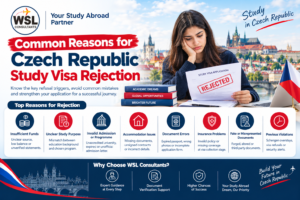
Insufficient funds, unclear study purpose, and document errors cause most Czech Republic study visa rejections. This guide helps international students spot common refusal triggers before they submit an application. It explains administrative standards set by consular officers and the Ministry of the Interior.
Rejected, Inadmissible or Discontinued: What Each Outcome Means
A rejected Czech Republic study visa application means the consulate reviewed your file and denied it based on statutory criteria. An inadmissible application means officials returned your file without evaluating it because you failed to meet an entry requirement for a Czech Republic study visa. A discontinued outcome means processing stopped because you withdrew your application or failed to submit missing documents within the legal deadline.
Applicants must distinguish between a long-term visa (Type D) and a long-term residence permit. The Type D visa covers stays up to one year, while the residence permit suits multi-year degree programs. Consular officers issue both documents under distinct procedural rules and statutory review timelines.
Top Reasons Czech Study Visas Get Rejected
The following subsections examine specific refusal grounds. They follow the exact frequency order found in competitor analysis and official data. Inspecting these errors helps applicants spot critical risks early. Every supporting document must match Ministry of the Interior standards.
Insufficient or Unclear Proof of Funds
A funds refusal occurs when bank statements fail to prove the required amount, ownership, or consistent balance. Consular officers reject files showing sudden account deposits without documented origin. Applicants often fail by presenting accounts under third-party names without legal sponsorship guarantees. Low daily balances before the application date also trigger immediate financial doubts. Additionally, unverified bank statements or missing official bank stamps lead directly to refusal.
Unclear Study Purpose
An unclear study purpose refusal occurs when an applicant’s academic history fails to match their chosen degree program. Consular officers evaluate your educational background to verify genuine academic intent. For example, an applicant with a bachelor’s degree in accounting who applies for a master’s degree in fine arts without relevant work experience creates immediate suspicion. This mismatch signals an illogical career path and leads officers to doubt your motivation for studying.
Ineligible Study Programme or Invalid Admission Letter
An admission refusal occurs when a study programme fails to meet legal criteria under Section 64 of Act No. 326/1999 Coll. The Ministry of the Interior requires accredited higher education programmes or approved language-preparation courses. Consular officers reject applications backed by unaccredited institutions or informal training programs. Additionally, submitting uncertified admission letters, expired acceptance documents, or unofficial program offer sheets directly leads to visa refusal.
Invalid Accommodation Proof
Valid accommodation proof requires a signed lease agreement, a landlord declaration, or official university dormitory confirmation. Proof becomes invalid when lease contracts lack the property owner’s official notarized signature. Consular officers reject accommodation documents with dates that do not cover the entire stay. Furthermore, submitting unverified hotel reservations, incorrect property register numbers, or unsigned host agreements triggers an immediate visa refusal.
Passport, Photo and Application Form Errors
Minor administrative mistakes in your basic application file lead to immediate visa processing delays or rejections. Consular officers reject passports that lack two blank pages or expire within three months of your planned departure. Photos must follow strict ICAO standards with clean white backgrounds and clear facial visibility. Also, application forms with unsigned fields, missing entries, or details that contradict supporting documents can lead to swift application refusals.
Insurance Problems at the Visa Collection Stage
Insurance issues block visa collection rather than causing the initial application refusal. Consular officers request valid travel medical insurance only after approving your visa application. Applicants must present comprehensive insurance from a certified provider covering the required medical limits. Submitting unapproved insurance policies, incorrect start dates, or policy documents without an official translation delays final visa issuance.
Fake, Forged or Misrepresented Documents
Document fraud includes presenting altered certificates or genuine papers belonging to another person. Consular officers detect forged bank statements, fake degree certificates, and altered housing contracts during background checks. Presenting genuine third-party documents without legal authorization also constitutes misrepresentation. Both practices result in an immediate visa refusal, entry bans across the Schengen Area, and permanent administrative records.
Previous Violations
Previous violations include prior Schengen overstays, visa refusals, or flagged security concerns. Consular officers evaluate your past travel history across all Schengen member states. A record of illegal stays or unpaid administrative fines raises serious compliance concerns. Additionally, serious infractions may trigger entry alerts in the Schengen Information System (SIS), which can lead directly to visa rejection.
Rejection Reasons Specific to Pakistani Students
Generic visa guides often overlook the strict, Pakistan-specific document verification chain required by the Czech consulate. Pakistani applicants must complete mandatory attestations through HEC and MOFA before the embassy superlegalizes documents. Furthermore, failure to meet NADRA registration matching, court-certified translations, and strict banking-origin checks can lead directly to application refusals.
Attestation and Superlegalization Mistakes
Failure to complete the sequential legalization chain invalidates your documents for Czech visa processing. Follow these steps to ensure legal document acceptance:
- HEC Attestation: First, authenticate your educational degrees through the Higher Education Commission.
- MOFA Attestation: Legalize all attested degrees and personal documents at the Ministry of Foreign Affairs.
- Czech Embassy Legalization: Complete final superlegalization directly at the Czech Embassy in Islamabad.
Police Clearance Certificate Problems
A police clearance refusal occurs when an applicant fails to submit a clean, properly legalized criminal record extract covering all relevant residences. Under Section 31 of Act No. 326/1999 Coll., the Ministry of the Interior requires a character certificate from Pakistan and any country where you resided for over six months in the last three years. Submissions fail when applicants present expired local certificates, omit MOFA attestation, or miss required sworn Czech translations. Additionally, unverified gaps or active criminal records trigger immediate application refusal.
Missing Czech Translations
Document rejection occurs when applicants fail to provide official Czech translations or submit expired papers. All submitted documents in foreign languages must include a sworn translation into the Czech language by an authorized translator. Consular officers reject self-translated papers, general English translations, and unverified summaries. Additionally, supporting documents like bank statements and police certificates must be under 180 days old on the submission date.
Risky Agent-Prepared Files
Third-party file creation triggers refusals when applicants cannot verify or explain submitted documents. Consular officers expect applicants to maintain direct control over every paper in their visa file. Files prepared using generic templates, untraceable bank guarantees, or standardized motivation letters raise immediate suspicion. During consular interviews, applicants must clearly explain their funding sources, academic plans, and the origins of their documents. Discrepancies between spoken answers and written submissions lead directly to visa rejections.
How to Read Your Czech Visa Refusal Letter
A Czech visa refusal letter states the legal grounds and facts behind your application rejection. Read your refusal notification in this specific order to plan your next steps:
- Check Legal Grounds: Identify the specific boxes marked under Act No. 326/1999 Coll.
- Review Written Reasonings: Read the detailed explanation provided by the Ministry of the Interior.
- Note the Decision Date: Calculate your appeal deadline starting from the formal delivery date.
- Identify the Appeal Authority: Confirm the exact ministry department assigned to receive your appeal.
What to Do After a Czech Study Visa Rejection
After receiving a rejection, applicants can submit a formal appeal or file a new visa application. A formal appeal asks the Ministry of the Interior to re-examine your file within 15 days of notification. Alternatively, submit a new application when you need to gather updated documents or correct major financial errors. Choose the option that best fits your grounds for refusal to protect your future travel plans.
Appeal Within 15 Days
Applicants must file a written appeal within 15 days of receiving their refusal letter. An appeal cannot introduce new facts or evidence you did not submit with your original application. Submit your written request directly to the Czech consulate that issued the refusal. Follow these crucial steps to complete the formal appeal process:
- Draft a Legal Statement: Detail the specific legal errors the Ministry of the Interior made.
- Translate into Czech: Have an authorized translator prepare the official Czech document.
- Pay the Administrative Fee: Include proof of the required appeal fee payment.
- Submit Original Copies: Deliver signed physical paperwork to the embassy within the 15-day limit.
Reapply After Fixing the Cause
You must resolve every cited refusal reason before submitting a new visa application. Consular officers review past rejection records when processing new file submissions. Reapplying with identical documents guarantees a second refusal. Fix underlying issues by updating financial records, securing official attestations, or selecting an eligible study program before booking a new appointment.
How to Avoid Czech Study Visa Rejection
A thorough pre-submission audit prevents common processing errors and safeguards your visa approval. Review your application against every key requirement before submitting your file to the consulate:
- Verify Financial Capacity: Ensure your bank account holds sufficient funds for your entire stay, supported by clear, traceable income sources.
- Confirm Study Purpose: Prepare for your consular interview to articulate your chosen degree, university program, and future career plans clearly.
- Check Program Eligibility: Confirm that your university program satisfies official accreditation rules under Czech higher education laws.
- Validate Accommodation Contracts: Submit a signed lease agreement or housing confirmation covering your entire stay and including notarized signatures.
- Audit Basic Documents: Check that your passport, application forms, and photos meet all standard administrative and ICAO rules.
- Complete Legalization Chains: Obtain all required attestations through HEC, MOFA, and the Czech Embassy before your appointment.
- Obtain Clean Police Certificates: Submit an updated character clearance certificate complete with official sworn Czech translations.
- Maintain File Ownership: Review every paper in your file personally to ensure full document transparency and accuracy.
Why Choose WSL Consultants
WSL Consultants helps applicants prevent study visa refusals through structured document verification and legal alignment. Our consultancy addresses the exact rejection risks outlined in this guide:
- Legalization Compliance: We verify your complete HEC, MOFA, and Embassy superlegalization sequence before submission.
- Financial Auditing: We review your bank statements and income-source proofs to meet the Ministry’s official threshold standards.
- Document Accuracy: We verify that all police clearances, housing contracts, and university admission papers contain accurate dates and sworn Czech translations.
- Interview Preparation: We prepare students for consular interviews to ensure clear explanations of academic intent and funding sources.