Common reasons for rejection of the Italian student visa
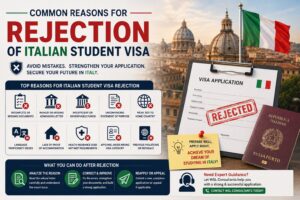 Securing university admission is a massive achievement, yet securing your visa requires strict compliance. Currently, the typical Italian study visa refusal rate averages around 12% to 15%. This guide acts as a proactive checklist to protect your journey to study in Italy and avoid common embassy rejection patterns.
How the Italian consulate evaluates applications
The Italian consulate assesses every file by strictly weighing it against Schengen visa guidelines and national study visa requirements. During this applicant profile assessment, visa officers exercise their discretion to verify four critical benchmarks. They look for total document completeness, unquestionable financial sufficiency, genuine student intent, and strong economic or familial ties to your home country. This thorough verification process ensures total immigration compliance before a visa is granted.
Applying under the wrong visa category
A frequent visa stream error involves confusing the strict 90-day visa limit. Selecting the Short-stay Schengen Visa Type C restricts your stay to a maximum of 90 days. This category only suits brief language courses or short summer schools.
If you enroll in a full academic track, you must apply for the National Visa Type D. This long-stay student visa is mandatory for complete degree programs. Choosing the wrong category triggers an instant rejection, forcing you to restart the entire application process.
Incomplete or missing documents
To the consulate, an incomplete file indicates a lack of preparation. This triggers an immediate application deferral or outright denial during document verification. Visa officers will not chase you for missing pages. They simply reject the file if it fails to meet the official criteria.
- Passport Validity: The passport expires less than three months after your intended departure date from Italy.
- Visa Application Form: Leaving mandatory sections blank or forgetting the required signature on the final page.
- Passport Photos: Submitting outdated photographs that violate strict ICAO biometric standards.
- Financial Proof: Missing the formal bank covering letter or failing to provide full bank statements.
- Accommodation Letter: Presenting an unconfirmed hotel booking or an incomplete host invitation form.
- Health Insurance: Providing a basic travel policy that excludes emergency medical repatriation coverage.
Invalid or missing university admission letter
Your official pre-enrollment summary from the Universitaly portal is a core requirement for a successful application. However, a letter becomes completely invalid if it features incorrect intake dates, lacks official institutional stamps, or fails to match your requested visa duration. Furthermore, many universities in Italy require a specific dichiarazione di valore (Declaration of Value) or a CIMEA statement. Missing this mandatory document makes your admission legally incomplete, leading to an immediate visa denial.
Weak ties to home country
Consulates strictly assess immigration risk to ensure applicants intend to return after their studies. If a visa officer believes you plan to overstay illegally, they will deny the application. Demonstrating strong local economic roots and social bonds remains the most effective way to counter this specific suspicion.
- Family Dependency Documents: Certified family registration certificates that prove your deep social ties at home.
- Property Ownership: Registered land titles or property deeds under your name or your sponsor’s name.
- Employment Letter: A formal job offer or a career path guarantee from a local company.
- Proof of Return: A well-structured statement explaining how this degree fits into the domestic job market.
Unconvincing statement of purpose
The consulate expects your Statement of Purpose to showcase a highly personalized academic roadmap. A successful essay must articulate specific reasons for choosing Italy, your selected university, and your exact degree program. Furthermore, you must outline a realistic post-study career plan that aligns with your domestic market. Submitting generic, copy-pasted templates or AI-generated narratives signals a lack of genuine intent, which serves as a very common trigger for immediate visa rejections.
Language proficiency issues
Failing to meet strict linguistic benchmarks is a major driver of modern visa refusals. For English-taught programs, submitting your application without a valid IELTS certificate or an authorized equivalent often triggers an immediate rejection. Similarly, if you enroll in an Italian-taught curriculum, you must present an officially recognized Italian language certification, typically at the A2 or B1 level minimum. In both scenarios, your certificate must be completely valid and align perfectly with the university’s specific, stated entry requirements.
Lack of proof of accommodation
The consulate requires confirmed accommodation covering at least your initial period of stay in Italy. You must provide a formal university dormitory letter, a registered and signed rental agreement, or an official host family declaration. Relying on basic hotel bookings alone is not sufficient, as officers view unverified reservations as an immigration risk. Failing to secure acceptable housing documentation implies an unstable arrival plan, which triggers a quick visa refusal.
Insufficient or unverifiable funds
The consulate demands indisputable proof that you can fully support yourself during your academic stay. If a visa officer detects erratic account patterns, they will swiftly issue a refusal. Therefore, your official bank statement must show a completely transparent, easily traceable financial history.
- Minimum Balance: Show at least €6,000 for each academic year.
- Account History: Provide six consecutive months of transactions with official branch stamps.
- Sponsor Letter: Include a notarized affidavit of support and valid tax returns.
- Red Flags: Avoid fresh, large cash deposits without a verified source.
Health insurance that does not meet requirements
Your student visa application requires a comprehensive health insurance policy that remains valid across the entire Schengen area. The policy must provide a minimum coverage of €30,000 for emergency medical expenses and repatriation costs. Applications commonly fail when students submit basic travel insurance featuring coverage gaps, insufficient limits, or an expiration date that falls before the requested visa end date.
Previous visa violations or refusals
Prior Schengen overstays and undisclosed previous refusals constitute major compliance hurdles during the evaluation process. The consulate systematically cross-checks your identity against the central Schengen entry and exit records to verify your immigration history. Crucially, the non-disclosure of a prior visa refusal is treated far more seriously than the actual refusal itself. Attempting to hide a past rejection constitutes misrepresentation, which triggers an automatic visa denial and a potential long-term ban.
Unacceptable medical conditions
Italy does not routinely reject student visa applications strictly on standard medical grounds. However, under unified Schengen rules, the consulate can issue a refusal if an applicant poses an apparent public health risk. Furthermore, serious pre-existing health conditions can severely impact your travel medical insurance eligibility. If your condition prevents you from securing a policy that fully covers emergency hospitalization and medical repatriation, the embassy will deny your application. Candidates navigating severe medical histories should carefully verify their insurance options before submitting their files.
What to do after rejection
Receiving a visa denial can feel incredibly discouraging, but you must act quickly and logically. Carefully read your official refusal letter to identify the precise legal grounds cited by the visa officer. Understanding this specific reason is your first critical step toward reversing the decision and securing your future academic path.
- Analyze the Refusal Letter: Pinpoint the exact box checked by the consulate to discover your specific application weakness.
- Correct the Core Issue: Rebuild your file by gathering stronger bank statements, updating insurance, or rewriting your statement of purpose.
- Reapply or Lodge an Appeal: Submit a fresh, flawless application or appeal through a regional administrative court based on your refusal grounds.
If you need expert guidance to fix your application errors, contact WSL Consultants today for a professional file assessment.
FAQs
Q1) What is the visa rejection rate in Italy?
Ans) Italy’s visa rejection rate is 11% generally, but it reaches 12% to 15% for student visas.
Q2) Can my visa be approved after rejection?
Ans) Yes, your visa can absolutely be approved after a rejection. You must submit a new application that directly fixes the specific reasons cited in your refusal letter.
Q3) Does VFS inform you if a visa is rejected?
Ans) No, VFS Global will not inform you whether your visa is approved or rejected. They only notify you via text, email, or online tracking that a decision has been made and your passport is ready for collection.
Q4) Is an Italian student visa easy to get?
Ans) An Italian student visa is highly accessible, featuring a relatively low rejection rate of around 11%. However, approval is never automatic and depends entirely on your preparation.