Common Reasons for Austria Study Visa Rejection
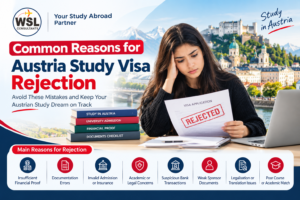
When you study in Austria, permit refusals typically stem from financial, documentation, admission, insurance, or legal issues. A Visa D is a short-stay visa used to enter the country and collect your card. A Residence Permit – Student (Aufenthaltsbewilligung – Student) is the long-term legal title that allows you to live and study there. Authorities deny permits when funds lack proper proof, health insurance fails to cover all risks, or academic admission is invalid. Missing legalizations, untranslated documents, or past Schengen overstays also trigger immediate refusals.
Why Austria Study Visa Applications Get Rejected
Austrian authorities assess every application strictly to determine if you meet all legal and documentary requirements under national immigration law. Refusals generally fall into a few clear categories:
- Insufficient Financial Proof: Failing to show enough funds for 12 months, unverified money sources, or ignoring extra costs for rent exceeding the standard cap.
- Documentation Errors: Submitting unlegalized, untranslated or expired certificates, as well as missing the deadline for requested documents.
- Invalid Admission or Insurance: Enrolling in non-qualifying courses or holding health insurance that does not cover all risks in Austria.
- Academic or Legal Concerns: Unclear study purpose, prior Schengen overstays, or submitting fraudulent information
What Can Lead to an Austria Study Visa Refusal?
Austrian immigration officers review every file with strictness. Each issue weakens your application distinctly. Understanding these specific refusal triggers helps you prevent avoidable mistakes.
Insufficient Financial Proof
Austrian authorities review your financial records to verify you have enough funds for living expenses. A main trigger for refusal is showing an insufficient bank balance that fails to meet annual minimum thresholds. Inadequate available funds, such as money locked in sanctioned banks or accounts inaccessible from Austria, also lead to rejection. Furthermore, unsupported financial claims like sudden lump-sum deposits without clear proof of origin arouse suspicion.
To avoid these errors, review the Austria study visa bank statement requirements page. Ensure your balance is stable, fully traceable, and meets all official requirements.
Unexplained Bank Transactions or Large Deposits
Austrian authorities evaluate financial credibility rather than just your total account balance. Unexplained deposits raise serious questions about the true source of funds. Sudden large transfers right before applying suggest borrowed money. Frequent irregular deposits without clear context also trigger deep suspicion. Weak supporting evidence fails to prove legal ownership of funds. Authorities reject applications if you cannot explain every transaction with tax returns, salary slips, or official affidavits.
Weak or Unverified Sponsor Documents
Austrian authorities inspect sponsor documents to confirm financial stability. A weak sponsor connection often leads to visa refusal. Distantly related sponsors carry low credibility. Authorities prefer parents or legal guardians.
Unverified employment or business evidence also creates suspicion. You must provide official tax records, business licenses, and pay slips. Unclear sources of income undermine your financial claim. Officers must see continuous income, not just account balances. Clear documents prove your sponsor can comfortably support your studies. Missing evidence directly weakens your financial proof.
Incomplete or Incorrect Documents
Austrian officials inspect every document for strict legal accuracy. Missing signatures, expired records, or omitted forms cause immediate application halts. Small formatting errors raise serious doubts about credibility. Common mistakes include mismatched birth dates across forms and inconsistent spelling of personal names. Unclear information delays processing or leads to direct refusal. Officers reject files that show conflicting facts, missing dates, or incorrect personal details.
Legalisation or Translation Problems
Austrian authorities enforce strict rules for verifying foreign documents from Pakistan. Missing proper legalisation or required translations leads directly to visa refusal. Pakistani public documents—such as police certificates, birth certificates, and degrees—require legalisation. They must be attested by relevant Pakistani authorities and the Austrian Embassy in Islamabad.
Not all documents require translation into German. English documents are often accepted, but non-English records must be translated by an official, sworn translator. Submitting documents with unverified translations or missing legalisation stamps creates legal invalidity. Always check specific embassy rules to ensure each document meets exact translation and verification requirements.
Problems With University Admission
Austrian visa authorities require official, valid admission evidence from a recognized Austrian university. Incomplete, conditional, or expired acceptance letters trigger swift application refusals.
Valid activities include full-time employment, professional training, running a business, or certified skill development. Provide work certificates, tax records, or course completion diplomas to cover every missing year. To ensure your full file aligns with official standards, review the Austria study visa requirements page. Complete, documented timelines protect your application from sudden rejection.
Unclear Study Purpose or Weak Motivation
Austrian officers carefully evaluate your motivation letter and study plan. You must clearly explain why you chose Austria, your specific university, and your degree program. A weak study plan fails to link your past education with your future career goals. Generic statements about European education raise doubts about your true academic intentions. Officers assess whether the degree logically advances your career in your home country. Clearly outline your academic pathway, course modules, and post-study career goals to show genuine study intent.
Failure to Meet Language Requirements
Language requirements depend on your chosen program and university. English-taught programs require recognised proficiency tests, while German-taught degrees demand official language certificates. Submitting insufficient test scores leads directly to application refusals. Officers also reject files that miss official test results or submit unverified language certificates. Universities set specific minimum score thresholds for admission. To check exact score standards, review the IELTS requirement for the Austria study visa page before applying.
Inadequate Health Insurance
Austrian authorities require comprehensive health insurance coverage for all international students. Submitting an invalid policy or missing insurance documents causes immediate permit refusal. Your insurance policy must cover all health risks across Austria without gaps. Travel insurance or basic policies with restrictive coverage caps fail to meet legal requirements. Ensure your policy offers full medical coverage, emergency hospitalization, and repatriation protection. Always verify that your insurer is recognized by Austrian immigration authorities.
Problems With Accommodation
Lacking fixed housing proof does not trigger an automatic visa refusal. Austrian authorities evaluate accommodation to ensure your living arrangements are realistic and credible. Officers check if proposed housing matches your financial assessment and university location. Unrealistic rent costs relative to reported income or contradictory addresses raise serious questions.
Poorly documented housing, such as unconfirmed dorm bookings or informal lease draft contracts, creates administrative delays. To budget properly, review the Austria cost of living page. Secured accommodation prevents unnecessary scrutiny of your financial plans.
Previous Visa Refusals
A prior visa refusal does not automatically trigger another rejection in Austria. Austrian immigration authorities assess each new application on its current merits and total documentation. The main risk stems from undisclosed previous refusals. Concealing past rejections on your application form creates severe issues regarding honesty and credibility.
Officers also reject applications if past refusal grounds remain unresolved. You must clearly show that previous financial, academic, or documentation shortcomings have been corrected.
Serious immigration history—such as active bans, deportations, or illegal stays—carries far greater weight than a standard visa refusal. Always declare your complete travel history and provide clear evidence showing how past issues were resolved.
False, Misleading, or Inconsistent Information
Submitting false or misleading information is a severe issue that leads to immediate visa refusal. Austrian authorities cross-check every claim across your application forms, supporting documents, and external databases.
Fraudulent documents—such as forged bank statements, fake work experience, or altered degree certificates—trigger permanent entry bans. Incorrect employment details or exaggerated salaries create major doubts about your overall file credibility.
Contradictory statements also raise flags. Mismatched details between your motivation letter, CV, and official forms indicate poor preparation or intentional deception. Always ensure every statement is accurate, fully verified, and consistent across all documents.
Failure to Meet General Residence Conditions
Austrian student residence permits depend on strict legal standards set by national settlement laws. Immigration authorities reject applicants who fail general residence conditions, regardless of university admission status. Sufficient livelihood remains a primary legal requirement. You must prove sustainable financial resources without relying on public welfare funds or unauthorized local employment.
Applicants must also satisfy public order and security checks. Unresolved criminal records, active Schengen entry bans, or public health risks lead to immediate refusal under official Austrian immigration rules.
Applying Under the Wrong Route or Category
Applying under the wrong entry route triggers an immediate rejection from Austrian immigration. Austrian study authorization is divided into distinct legal categories based on stay duration, not a single generic “student visa”.
Late or Poorly Planned Application
Late or poorly organized preparation causes major operational delays that undermine your visa process. While submitting an application close to a start date does not guarantee a refusal, rushing through requirements leads to missing evidence and missed intake deadlines. Unplanned applications often fail during document preparation. Foreign attestation, legalisation stamps, and official translations require weeks to complete before your file is ready for submission.
Securing embassy or application center submission appointments takes time during peak seasons. Delays in obtaining an appointment slot push your visa decision past your university registration deadline. Always plan your timeline early to gather compliant documents and accommodate standard processing schedules.
What to Do Before Submitting an Application
Before submitting your application, you must carefully audit every part of your file. First, secure proof of sufficient funds held for a full 12 months, supported by clear source-of-funds evidence and official tax records. Ensure you hold an unconditional admission letter from a recognized Austrian university with matching course details and valid start dates.
All application forms must be fully signed, updated, error-free, and consistent across your entire file. Verify that your documents carry proper legalisation stamps from relevant local ministries and the Austrian embassy.
Your health insurance must offer comprehensive coverage in Austria without restrictive gaps. Include a valid language proficiency certificate that meets your university’s exact score thresholds. Finally, check for total alignment across your personal details, dates, employment history, and study plan to prevent discrepancies.
Can You Reapply After an Austria Study Visa Rejection?
Yes, you can reapply after a refusal. Austrian law allows new applications, but submitting identical files causes another rejection. First, review your official decision letter (Bescheid) to identify the exact refusal reasons. You must correct every issue—such as financial gaps, missing legalisation, or health insurance defects—before reapplying.
You have two options: submit a new application with corrected documents or file a formal appeal (Beschwerde) in German within the specified deadline if the refusal was made in error. Seeking guidance from WSL Consultants helps you address the grounds for the past refusal and submit a compliant file.