Best Courses in Austria for Pakistani Students
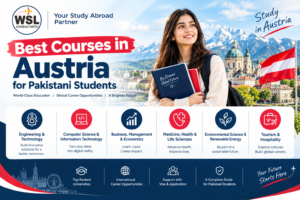
Austria is a key destination for higher education. Pakistani students can choose from a wide range of academic fields at Austrian institutions. Popular fields include Engineering, Computer Science, Business, Medicine, Environmental Studies, and Tourism. Choosing the right course depends on your academic background, career goals, preferred language, and intended degree level. Prospective applicants must also check all requirements for an Austria study visa before applying.
What Are the Best Courses to Study in Austria?
The best courses in Austria cover Engineering, Computer Science, Business Administration, Environmental Sciences, and Tourism Management. The best option depends on your education and professional goals. Bachelor’s degrees build core theoretical foundations, while Master’s programs offer advanced, specialized training. No single program is universally superior, as the best option varies across public and private universities in Austria. Detailed information on each academic path follows below.
Engineering and Technology
Engineering and Technology forms a core pillar of higher education in Austria. Students can pursue specialized degrees in Mechanical, Electrical, Civil, Mechatronics, and Automation Engineering. These curricula blend theoretical science with practical technical application. Coursework covers advanced mathematics, physics, computer-aided design, system modeling, and materials science. Students develop skills in structural analysis, circuit design, control systems, and automated production processes.
An ideal background for Pakistani applicants includes an FSc Pre-Engineering qualification for admission to a Bachelor’s program. Applicants targeting Master’s programs need a relevant undergraduate engineering degree. Admission criteria, language requirements, and entry exams vary by university and specific study track. Top technical institutions in Austria include TU Wien, TU Graz, and Johannes Kepler University Linz.
Computer Science and Information Technology
Computer Science and Information Technology programs represent fast-growing technology fields in Austrian higher education. Students can enroll in degrees covering Computer Science, Software Engineering, Cybersecurity, Information Technology, and Business Informatics. Theoretical computer science programs focus on core computational theory, algorithm design, software architecture, and system hardware. Specialized IT and Business Informatics tracks emphasize deploying network systems, managing organizational databases, and integrating technology solutions into commercial business workflows.
Coursework across these pathways covers programming languages, relational databases, operating systems, network protocols, and enterprise information systems. Suitable academic backgrounds for Pakistani applicants to Bachelor’s programs include ICS or FSc Pre-Engineering. Master’s candidates typically require a relevant Bachelor’s degree in Computer Science, Software Engineering, Mathematics, or Engineering. Leading institutions for technology degrees include TU Wien, TU Graz, and Johannes Kepler University Linz.
Business, Management and Economics
Business-related degree programs in Austria serve students aiming for international commercial careers. Available specializations include Business Administration, International Business, Finance, Economics, Management, and Supply Chain Management. Coursework covers core principles of microeconomics, corporate finance, accounting, global supply chains, strategic marketing, and organizational leadership. Students analyze real-world market operations, quantitative data sets, trade regulations, and administrative management structures.
Pakistani applicants holding an ICom or FA in relevant subjects can apply for Bachelor’s programs. Candidates seeking Master’s-level admission usually need a relevant Bachelor of Business Administration (BBA) or a BS in Economics, Commerce, or Accounting. Specific entry requirements vary by institution, particularly for quantitative economics or specialized finance degrees that require more credits in mathematics and statistics. Prominent business institutions in Austria include Vienna University of Economics and Business (WU) and the University of Vienna.
Medicine, Health and Life Sciences
Medicine, Health, and Life Sciences represent distinct academic pathways within Austrian higher education. Public programs split into clinical medicine and non-clinical health sciences. Clinical Human Medicine and Dentistry degrees follow strict, nationwide entrance protocols. Clinical training takes place entirely in German. Applicants must pass the written MedAT entrance exam, which is held in German every July. Seat allocation for non-EU candidates is capped at 5%.
Non-clinical options include Public Health, Biotechnology, Biomedical Sciences, and Bioengineering. Universities of Applied Sciences offer several Master’s programs in these technical fields taught in English. Suitable Pakistani backgrounds include FSc Pre-Medical or a relevant Bachelor’s degree in biological sciences. Admission routes vary significantly depending on language proficiency and the target program. Top institutions in this sector include Medical University of Vienna, Medical University of Graz, and FH Campus Wien.
Environmental Science and Renewable Energy
Environmental Science and Renewable Energy programs focus on sustainability and climate solutions within Austrian universities. Curricula are divided into pure scientific tracks and technical engineering disciplines. Scientific programs cover climate dynamics, soil analysis, water conservation, and ecosystem restoration. Engineering options focus on smart grid design, clean technology, biomass processing, and energy storage systems.
Students study environmental policy, pollution control, resource management, and renewable generation methods. Pakistani applicants with FSc Pre-Engineering or FSc Pre-Medical qualify for relevant Bachelor’s degrees. Master’s programs require an undergraduate degree in engineering, chemistry, biology, or environmental sciences. Notable institutions in this field include BOKU University Vienna, TU Wien, and FH Upper Austria.
Tourism and Hospitality Management
Tourism and Hospitality Management degree programs provide practical academic training across Austria. Available courses include Tourism Management, Hospitality Management, Hotel Management, and Innovation in Tourism. Tourism-focused studies concentrate on macro-level regional development, policy, and destination marketing. Hospitality and hotel management programs emphasize micro-level commercial operations, service quality, food service, and resort administration.
Coursework addresses destination management, hotel operations, digital tourism marketing, service design, and financial administration. Students learn intercultural communication, revenue management, and sustainable tourism strategies. Pakistani applicants holding an ICom, FA, or relevant business background can apply for Bachelor’s degrees. Master’s candidates need a relevant undergraduate qualification in business or social sciences. Prominent institutions offering English-taught programs in this field include Modul University Vienna and FH Salzburg.
How to Choose the Right Course in Austria
Choosing the right degree requires assessing your academic background, administrative requirements, and total financial commitment. Academic eligibility depends directly on past qualifications. Pakistani students applying for Bachelor’s degrees must hold an intermediate certificate, such as FSc, ICom, or FA, or equivalent A-Levels. Master’s degree applicants must present a relevant four-year undergraduate degree with compatible course credits. Each academic faculty enforces program-specific admission guidelines, entry exams, or credit-matching criteria. Confirming these conditions early on university study portals ensures a smooth application process.
Language proficiency dictates degree choices across Austrian institutions. English-taught programs predominantly exist at the Master’s level and at specialized Universities of Applied Sciences (Fachhochschulen). These programs typically require proof of English proficiency through official tests such as IELTS or TOEFL. Meeting specific IELTS requirements for an Austria study visa and university admission helps non-EU candidates ensure smooth processing. Conversely, most Bachelor’s degrees at public research institutions are taught in German, requiring B2 or C1 proficiency certificates.
Tuition fees and overall living costs represent critical evaluation factors for non-EU candidates. Public research universities charge non-EU/EEA students approximately €726.72 per semester, plus a compulsory Austrian Student Union (ÖH) fee. Private institutions set their own tuition rates, which are typically higher per academic year. Managing living costs in Austria requires careful planning, with monthly expenses for accommodation, food, health insurance, and transport averaging €950 to €1,400, depending on the city.
Students should compare Austrian universities by evaluating course structures, locations, and study formats. Public institutions focus on theoretical research, while Universities of Applied Sciences offer hands-on practical training. Aligning course choices with career goals helps narrow options, though completing a degree does not guarantee employment. Carefully review admission pathways, language requirements, and realistic budgets to make well-informed decisions, while meeting all official Austria study visa requirements.
Documents Needed to Apply for an Austrian Course
University admission documents differ from visa application documents. Austrian higher education institutions set specific academic prerequisites for enrollment. Applicants must submit attested academic certificates, secondary school credentials, and official transcripts. Master’s candidates must provide previous undergraduate degree certificates and detailed course descriptions. Most English-taught programs require proof of language proficiency through tests like IELTS or TOEFL.
Candidates must submit a valid passport and government identification. Many programs require a CV, letters of recommendation, portfolios, or entrance exam results. Knowing how to write a motivational letter tailored to your target program remains critical to admission success. The exact document checklist depends on the specific university and chosen course.
How WSL Consultants Helps Pakistani Students Choose an Austria Course
WSL Consultants guides Pakistani students through selecting appropriate degree programs at Austrian higher education institutions. Advisory services begin with an assessment of your academic profile. Evaluators analyze past qualifications, GPA, transcript details, specific subject credits, and language skills to determine eligibility for public research universities or Universities of Applied Sciences.
Counselors match students with specific courses and universities based on academic backgrounds and long-term career goals. The team assists with application steps and document compilation, including legalizing academic records, writing tailored motivation letters, preparing CVs, and verifying English or German language credentials.
Following university admission, WSL Consultants assists applicants with Austria study visa preparation. Guidance covers organizing financial proof, arranging compliant travel health insurance, securing proof of local accommodation, and scheduling embassy submission appointments. Book a profile assessment with WSL Consultants today to explore eligible study options in Austria.